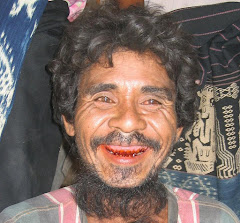
This encounter was fortunate, as the campesino pointed out the correct way. After some more driving on the moonscape, we came upon a small lake, with a rural community on its shore, and eventually on to a good metalled road to Juliaca.
The reason for this detour from the main road was because of a strike, or protest, by the campesinos, apparently against an increase in taxes and transport costs. They were putting up roadblocks on the main roads and stopping any transport from getting through. We wanted to leave Puno, a town on
On the outskirts of Puno, we met our first roadblock - a line of burning tyres completely blocking the road, with a few people around it. As soon as he saw this roadblock, our driver took a minor road to the left, meaning to bypass the roadblock using side roads. And that is what led us to the moonscape at
The adventure did not stop when we got back on the metalled road to Juliaca. On arriving at Juliaca, at about
When the bus left, heading northwest to

 Combative campesinos
On one of the other buses there was a French-Canadian whom we immediately nicknamed “Indiana Jones”. He was dressed in brown leather pants, with matching brown waistcoat, and a leather hat with flaps covering the ears. After some time at the roadblock, Indiana Jones left the bus and started arguing with the leader of the campesinos, using fluent Spanish. The discussion became more heated and the Canadian began challenging them to a fight. There was no reaction from the campesinos, however, which was probably fortunate! Eventually, after a couple of hours at this roadblock, we were “allowed” to remove the boulders ourselves. Obviously we were pleased to be on our way, however, only a few kilometers away we met the second roadblock!

Indiana Jones
The same routine started again, discussions and heated arguments, until eventually we were allowed to remove the roadblock and continue on our way. This happened so many times, maybe five or six times, that I lost track. At one of the roadblocks, a couple of police officers arrived, and we thought, “Ah, now all will be OK”. However, the police did not order the strikers away, but simply tried to negotiate with them. They did not win the argument and eventually left! So it simply took longer until we were allowed to remove the roadblock. In the end, these roadblocks lost their novelty and merely became a great nuisance. I really could not see what the campesinos were getting out of it, as they were only annoying us visitors, and not harming the people they wanted to get at.
Unfortunately for travellers, strikes and protests are becoming more frequent in

Children of the Andes
There is obviously the magnificent and famous

The face of Machu Picchu
 Machu Picchu
When visiting

Climbing Mt Putukusi
Even though the Spaniards killed Tupac Amaru I and his son, a daughter survived, and, 200 years later, in 1780, a direct descendant assumed the name Tupac Amaru II and led a great rebellion that came close to ending Spanish rule. However, this was not to be, and Tupac Amaru II was cruelly executed, together with his family, in the same square that had witnessed the death of his great-great-grandfather two centuries before. He was forced to watch as his wife, uncle and eldest son had their tongues torn out and subsequently garroted. The Spaniards reserved a special fate for the Inca himself: his limbs were attached to horses, which were then spurred in four directions. But the Inca’s body resisted this symbolic rending of the Inca empire. He was returned to the gallows, where he was disemboweled while still alive and then hacked to pieces. The bodies of the executed Incas were then dispersed throughout the rebellious provinces.
Today’s

Other Inca sites near

Salt Pans at 10,000 feet
Of course

Los Uros
 Uros lady
We also visited
Then there is

In the Pacific coast, just off Pisco, there are the amazing Islas Ballestas, situated in the Paracas National Reserve, or the Peruvian Galapagos. You cannot land on the islands, but a boat will take you very close to the shore. The islands are covered with guano (bird droppings), highly prized as a fertilizer, and harvested when it reaches several metres depth. In the past, guano was a strategic commodity, in fact, the War of the Pacific between the Peru-Bolivia alliance and
On the islands you will see tons of birds, including pelicans, flamingos, penguins, cormorants, red boobies and terns, that seem to cover every inch of land. Thousands of birds fly in formation just over the water. You will also see sea lions and dolphins, and there are also supposed to be whales and turtles, although we did not see any. What you see is more than enough though!

Sea lions-Islas Ballestas
In
From this brief description, it is evident that
We had gone for a day's rafting on the
The rafting agency we used, Bundu Adventures, is owned by Daniel, a Frenchman born in
First, we had to walk down the steep side of the gorge to the river. This was probably the most dangerous part of the adventure, and it's specifically mentioned in the indemnity form! Having got down to the riverside safely, we found the rafting team pumping up our three inflatable dinghies. The descent path is too narrow for inflated dinghies. This did not take long, and we took our places for the start of an unforgettable experience. Our steersman was Timba, a 27-year old Zambian with bulging muscles. Three of us crouched on each side of the raft, while Timba sat at the back, using a long oar as a rudder. Along with us in the river were four kayaks, single-man canoes where the canoeist almost forms part of the canoe. They are practically unsinkable if they do not hit a solid hard object. It flips over, but the experienced canoeist always manages to right it almost immediately. Very soon, we found the reason for these kayaks!

We pulled out into a grade five rapid in the main part of the river, the appropriately-named Gnashing Jaws of Death! On hitting the rapid, we immediately flipped over! This was my first introduction to white-water rafting! After some time, one of the canoeists picked me up and took me back to our raft, now the right side up. Most of the team was already there.
Once we got ourselves together, we attempted the rapid again, and this time passed through without overturning. We proceeded down the river and through the next few rapids, safely and upright. The problem with our raft was the crew, not the steersman! In order to go through the rapids safely, you need to "shoot" the rapids. This calls for strong efforts by the oarsmen, and everyone has to pull their weight. Apart from my friend and I, there were two French couples. The girls did not look very strong, and one of the French men looked scared out of his wits. He said that he had not expected to end up in the river, and he almost expected the organisers to guarantee that we would not have another mishap!
At Rapid 16, the Terminator, we did it again. This time we had more experience, at least with flipping, so we managed to hold on to the upside-down raft using the ropes at the side. After this flip-over, we managed to make it through to the end with an upright raft! A total of about 25km down the

The rafting team
Obviously this trip did not just consist of the

Lusaka crowd

Scaramanga Universal Services
After
 Sunset in Zanzibar
 Going to
 Zebra crossing
 On a safari, one can choose between accommodation in tents or in "lodges". The lodges are basically small hotels in the park itself, with an electricity generator (usually switched off at night) and the usual hotel amenities. Obviously these are more expensive than the tents. We tried both. The lodges are more comfortable, but the tents provide a more authentic experience, as they are situated in the park itself and are not fenced off. Intrusive animals such as baboons are continuously wondering around during the day looking for something to steal. And zebras and wild pigs come into the tent area at night. Apparently the wild pigs can be dangerous and have been known to knock down a tent if the smell something they fancy! So we were told to lock up food and our boots in the Toyota Landcruiser during the night. This bit about the boots gave a German travelling with us a bit of a problem. He wanted to be able to put on his boots in the night, in case he needed to go out for a call of nature! So, in his opinion, the tent area should be fenced.
The lodges can sometimes provide an experience on their own. One lodge we stayed at was close to a hippo pool. The pool is a place where a group of hippos stay during the day, as their skin cannot bear the heat of the sun. But they will come out at night and wonder the area around the pool. The hippopotamus is the most dangerous animal in
During the night at this lodge, a hippo came right up to our room window. We were a bit wary of taking photos with a flash, having heard of the hippo’s reputation, and considering there was only a large piece of glass between us and the animal. So we thought it best to leave him in peace! After a while, he turned around and left, presumably to go back to his pool. And we were left in peace to continue on our journey back to
1. You must answer according to my questions. Do not turn them away.
2. Do not try to hide the facts by making pretexts of this and that. You are strictly prohibited to contest me.
3. Do not be a fool for you are a chap who dares to thwart the revolution.
4. You must immediately answer my questions without wasting time to reflect.
5. Do not tell me either about your immoralities or the revolution.
6. While getting lashes or electrification you must not cry at all.
7. Do nothing. Sit still and wait for my orders. If there is no order, keep quiet. When I ask you to do something, you must do it right away without protesting.
8. Do not make pretexts about Kampuchea Krom in order to hide your jaw of traitor.
9. If you do not follow all the above rules, you shall get many lashes of electric wire.
10. If you disobey any point of my regulations, you shall get either ten lashes or five shocks of electric discharge.
These words were written on the wall of each cell of Tuol Sleng, a security prison of the Pol Pot regime in Phnom Penh, the capital of Cambodia. Tuol Sleng, or S-21 (Security Office 21), was housed in a converted high school in a quiet suburb of Phnom Penh. The location itself, amidst a residential area of Phnom Penh, is all the more chilling for its location. Any visit to Cambodia is not complete without a visit to this prison, now turned into a museum, to see the atrocities committed by the Khmer Rouge (Red Khmer) regime between 1975 and 1979.

Cambodia as a country is only just recovering from thirty years of civil war. Pol Pot himself, the leader of the Khmer Rouge, died relatively recently, in 1998 (April 15). In fact, some people do not believe he has died, as he was cremated soon after he died, without any official autopsy. And the Khmer Rouge, as a party, were officially outlawed in the same year, 1998, that is, over twenty years after they committed the atrocities, mass murders, and genocide of the 1970s.
Pol Pot, Brother Number One in the Khmer Rouge regime, is a name that still sends shivers down the spine of most Cambodians and foreigners alike. It was Pol Pot who was most associated with the bloody madness of the regime he led between 1975 and 1979. During this time, millions of Cambodians were killed or starved to death in "The Killing Fields", immortalised in Roland Joffe's 1984 film of the same name. After the Khmer Rouge's overthrow in 1979, by the Vietnamese army, Pol Pot fled to the jungle near the Thai border, and the Khmer Rouge continued engaging in guerrilla warfare aimed at demoralising its opponents. During this time, they were supplied with aid and military equipment by the Chinese, supported by the USA. And the USA also provided diplomatic support to the Khmer Rouge, and backed the Khmer Rouge delegate as the official representative of Cambodia at the UN. For the remainder of Pol Pot's life, just knowing he was still alive was traumatic and unjust for the Cambodian people. Nowadays, 20th May is National "Hate" Day in Cambodia, to mark public anger against the Khmer Rouge-led genocide.
Pol Pot was born Saloth Sar in a small village in Cambodia in 1925. He had a relatively privileged upbringing, and, as a young man, he spent several years studying in Paris. Apparently it was here that he developed his radical Marxist beliefs. Back in Cambodia, Saloth Sar became a schoolteacher, entered politics in the late 1950s and joined the Khmer Rouge in the 1960s. He became its leader in the 1970s, and took over Phnom Penh, and practically the whole of Cambodia in 1975.
Cambodia has had a turbulent history since WWII, highlighted by Japanese occupation in WWII, the French-Viet Minh war in neighboring Vietnam and Laos, declaration of independence in 1953, and the American intervention in Vietnam, Laos, and Cambodia itself in the 1960s and 1970s. Between 1969 and 1973, huge areas of eastern Cambodia were carpet-bombed by US B-52s in a secret programme to eradicate suspected communist base camps. This bombing (more than 500,000 tons) killed uncounted thousands of civilians and turned hundreds of thousands more into refugees. At that time, Cambodia was run by Lon Nol, who was installed and supported by the USA, and the Khmer Rouge were fighting to overthrow his regime. The US bombing alienated large segments of the population, enabling the Khmer Rouge to grow rapidly by recruitment. Despite massive US military and economic aid, Lon Nol never succeeded in gaining the initiative against the Khmer Rouge, and, on 17th April 1975 (two weeks before the fall of Saigon), Phnom Penh surrendered to the Khmer Rouge.
 Clearing landmines
Upon taking Phnom Penh, the Khmer Rouge implemented one of the most radical and brutal restructurings of a society ever attempted; its goal was to transform Cambodia into a Maoist, peasant-dominated, agrarian co-operative. Within two weeks, the entire population of Phnom Penh and provincial towns, including hospital patients, was forced to march out to the countryside and organised into slave-labour teams to work for twelve to fifteen hours a day. The advent of Khmer Rouge rule was proclaimed "Year Zero". Currency was abolished and postal services were halted. Except for one fortnightly flight to Beijing (China was providing aid and advisors to the Khmer Rouge), the country was cut off from the outside world.
It is still not known how many Cambodians died at the hands of the Khmer Rouge over the next four years. Estimates range from one to three million (the population was then around seven million). Tuol Svay Prey High School was taken over by Pol Pot's security forces. Tuol Sleng, or S-21, became the largest centre of detention and torture in the country. More than 17,000 people held at S-21 were taken to the extermination camp of Choeung Ek (15 kms from central Phnom Penh) to be executed. After digging their own graves, the favourite method of execution was a blow to the back of the head, and then the throat was slit.


Inside the memorial stupa
 The stupa - A closer look
Like the Nazis, the Khmer Rouge was meticulous in keeping records of its barbarism. Each prisoner who passed through S-21 was photographed, sometimes before and after being tortured. The museum displays room after room of these photographs of men, women and children covering the walls from floor to ceiling; virtually all the people pictured were later killed. Several foreigners from Australia, France and the USA were held here before being murdered. In S-21, the prisoners were kept in small cells and shackled with chains fixed to the walls or the concrete floors. Prisoners held in the large mass cells had one or both of their legs shackled to short or long pieces of iron bars. Other rooms in S-21 were used as interrogation rooms, using various methods of torture. The instruments of torture are on display in glass cases in the museum, and the methods are depicted in paintings by some of the very few prisoners who remained alive. Young boys were indoctrinated and used as prison guards. As the Khmer Rouge revolution reached new heights of insanity, it began devouring its own children. Groups of executioners and torturers who worked here killed their predecessors, and were in turn killed by those who took their places.
During its regime, the xenophobic government in Phnom Penh instigated a series of border clashes with Vietnam. In December 1978, Vietnam launched a full scale invasion of Cambodia (which invasion was condemned by both China and the USA), toppling the Pol Pot government in January 1979. On entering Phnom Penh, and the Tuol Sleng prison, they found only seven prisoners alive. Fourteen others had been tortured to death as Vietnamese forces were closing in. Photographs of their gruesome death are on display in the rooms were their decomposing forces were found. Their graves are nearby in the courtyard.
Of course, there is a lot more to see in Cambodia apart from the remnants left by the Khmer Rouge regime. The scenery is typical Indochina, mainly flat plains, rice fields and rivers. The two main geographical features are the Tonle Sap Lake, in the centre of Cambodia, and the Mekong River, which passes through Phnom Penh, in the southern part of Cambodia. The Tonle Sap is linked to the Mekong at Phnom Penh by a 100-km-long channel known as the Tonle Sap River. In the rainy season (May to October) the level of the Mekong rises, backing up the Tonle Sap river and causing it to flow north-west into the Tonle Sap lake. During this period, the Tonle Sap lake swells from 3000 sq km to over 7500 sq km. As the water level of the Mekong falls during the dry season, the Tonle Sap river reverses its flow, draining the waters of the lake back into the Mekong. This extraordinary process makes the Tonle Sap one of the world's richest sources of freshwater fish.
And then there are the temples of Angkor, in the northern part of Cambodia. These are considered one of the foremost architectural wonders of the world. The Angkor temples were built between the 9th and 14th centuries, when Khmer civilisation was at the height of its extraordinary creativity. From Angkor, the kings of the mighty Khmer empire ruled over a vast territory that extended from the tip of what is now southern Vietnam to Yunan in China and from Vietnam west to the Bay of Bengal. Angkor's 100 or so temples constitute the sacred skeleton of a spectacular administrative and religious centre. Its houses and public building have long since decayed away, as they were built of wood - the right to structures of bricks or stone was reserved for the gods.
The Khmer empire went into decline after the death of Jayavarman VII around 1220. The Thais sacked Angkor in 1351, and in 1431 they sacked it again. Until the 19th century, Angkor was "lost" to the outside world, and was overrun by the jungle. It was then "discovered" in the 1860s by French explorers, and this created a great deal of interest in Cambodia. From that time on, Angkor became the target of French expeditions.
The temples of Angkor are spread over about 100 sq km. The chief attractions are Angkor Wat, the "city" of Angkor Thom (principally the Bayon), and Ta Phrom. Ta Phrom is famous for having been left to the jungle, with dislodged stones and massive trees growing straight through the walls, and it is truly amazing. It was also the location for part of the filming of the Tomb Raider movie, starring Angeline Jolie as Lara Croft.


There are many other interesting things to sample in Cambodia, such as the delicacy of the town of Skuon: deep-fried four-inch spiders. And one can also see land-mine-clearing teams at work in the countryside around Siem Reap, near Angkor. Cambodia might not be on everyone's itinerary, but it is definitely a most interesting travel experience.


Buddhist monk with acolytes
 Discussing a tricky point
 Twas brillig, and the slithy toves
Did gyre and gimble in the wabe:
All mimsy were the borogoves,
And the mome raths outgrabe.
"Beware the Jabberwock, my son!
The jaws that bite, the claws that catch!
Beware the Jubjub bird, and shun
The frumious Bandersnatch!"
He took his vorpal sword in hand:
Long time the manxome foe he sought—
So rested he by the Tumtum tree,
And stood awhile in thought.
And, as in uffish thought he stood,
The Jabberwock, with eyes of flame,
Came whiffling through the tulgey wood,
And burbled as it came!
One, two! One, two! And through and through
The vorpal blade went snicker-snack!
He left it dead, and with its head
He went galumphing back.
"And hast thou slain the Jabberwock?
Come to my arms, my beamish boy!
O frabjous day! Callooh! Callay!"
He chortled in his joy.
'Twas brillig, and the slithy toves
Did gyre and gimble in the wabe:
All mimsy were the borogoves,
And the mome raths outgrabe.
Twas brillig, and the slithy toves
Did gyre and gimble in the wabe:
All mimsy were the borogoves,
And the mome raths outgrabe.
"Beware the Jabberwock, my son!
The jaws that bite, the claws that catch!
Beware the Jubjub bird, and shun
The frumious Bandersnatch!"
He took his vorpal sword in hand:
Long time the manxome foe he sought—
So rested he by the Tumtum tree,
And stood awhile in thought.
And, as in uffish thought he stood,
The Jabberwock, with eyes of flame,
Came whiffling through the tulgey wood,
And burbled as it came!
One, two! One, two! And through and through
The vorpal blade went snicker-snack!
He left it dead, and with its head
He went galumphing back.
"And hast thou slain the Jabberwock?
Come to my arms, my beamish boy!
O frabjous day! Callooh! Callay!"
He chortled in his joy.
'Twas brillig, and the slithy toves
Did gyre and gimble in the wabe:
All mimsy were the borogoves,
And the mome raths outgrabe.
There was a time when our people covered the land as the waves of a wind-ruffled sea cover its shell-paved floor, but that time long since passed away with the greatness of tribes that are now but a mournful memory. I will not dwell on, nor mourn over, our untimely decay, nor reproach my paleface brothers with hastening it, as we too may have been somewhat to blame.
Youth is impulsive. When our young men grow angry at some real or imaginary wrong, and disfigure their faces with black paint, it denotes that their hearts are black, and that they are often cruel and relentless, and our old men and old women are unable to restrain them. Thus it has ever been. Thus it was when the white man began to push our forefathers ever westward. But let us hope that the hostilities between us may never return. We would have everything to lose and nothing to gain. Revenge by young men is considered gain, even at the cost of their own lives, but old men who stay at home in times of war, and mothers who have sons to lose, know better.
Our good father in Washington--for I presume he is now our father as well as yours, since King George has moved his boundaries further north--our great and good father, I say, sends us word that if we do as he desires he will protect us. His brave warriors will be to us a bristling wall of strength, and his wonderful ships of war will fill our harbors, so that our ancient enemies far to the northward -- the Haidas and Tsimshians -- will cease to frighten our women, children, and old men. Then in reality he will be our father and we his children. But can that ever be? Your God is not our God! Your God loves your people and hates mine! He folds his strong protecting arms lovingly about the paleface and leads him by the hand as a father leads an infant son. But, He has forsaken His Red children, if they really are His. Our God, the Great Spirit, seems also to have forsaken us. Your God makes your people wax stronger every day. Soon they will fill all the land. Our people are ebbing away like a rapidly receding tide that will never return. The white man's God cannot love our people or He would protect them. They seem to be orphans who can look nowhere for help. How then can we be brothers? How can your God become our God and renew our prosperity and awaken in us dreams of returning greatness? If we have a common Heavenly Father He must be partial, for He came to His paleface children. We never saw Him. He gave you laws but had no word for His red children whose teeming multitudes once filled this vast continent as stars fill the firmament. No; we are two distinct races with separate origins and separate destinies. There is little in common between us.
To us the ashes of our ancestors are sacred and their resting place is hallowed ground. You wander far from the graves of your ancestors and seemingly without regret. Your religion was written upon tablets of stone by the iron finger of your God so that you could not forget. The Red Man could never comprehend or remember it. Our religion is the traditions of our ancestors -- the dreams of our old men, given them in solemn hours of the night by the Great Spirit; and the visions of our sachems, and is written in the hearts of our people.
Your dead cease to love you and the land of their nativity as soon as they pass the portals of the tomb and wander away beyond the stars. They are soon forgotten and never return. Our dead never forget this beautiful world that gave them being. They still love its verdant valleys, its murmuring rivers, its magnificent mountains, sequestered vales and verdant lined lakes and bays, and ever yearn in tender fond affection over the lonely hearted living, and often return from the happy hunting ground to visit, guide, console, and comfort them.
Day and night cannot dwell together. The Red Man has ever fled the approach of the White Man, as the morning mist flees before the morning sun. However, your proposition seems fair and I think that my people will accept it and will retire to the reservation you offer them. Then we will dwell apart in peace, for the words of the Great White Chief seem to be the words of nature speaking to my people out of dense darkness.
It matters little where we pass the remnant of our days. They will not be many. The Indian's night promises to be dark. Not a single star of hope hovers above his horizon. Sad-voiced winds moan in the distance. Grim fate seems to be on the Red Man's trail, and wherever he will hear the approaching footsteps of his fell destroyer and prepare stolidly to meet his doom, as does the wounded doe that hears the approaching footsteps of the hunter.
A few more moons, a few more winters, and not one of the descendants of the mighty hosts that once moved over this broad land or lived in happy homes, protected by the Great Spirit, will remain to mourn over the graves of a people once more powerful and hopeful than yours. But why should I mourn at the untimely fate of my people? Tribe follows tribe, and nation follows nation, like the waves of the sea. It is the order of nature, and regret is useless. Your time of decay may be distant, but it will surely come, for even the White Man whose God walked and talked with him as friend to friend, cannot be exempt from the common destiny. We may be brothers after all. We will see.
We will ponder your proposition and when we decide we will let you know. But should we accept it, I here and now make this condition that we will not be denied the privilege without molestation of visiting at any time the tombs of our ancestors, friends, and children. Every part of this soil is sacred in the estimation of my people. Every hillside, every valley, every plain and grove, has been hallowed by some sad or happy event in days long vanished. Even the rocks, which seem to be dumb and dead as the swelter in the sun along the silent shore, thrill with memories of stirring events connected with the lives of my people, and the very dust upon which you now stand responds more lovingly to their footsteps than yours, because it is rich with the blood of our ancestors, and our bare feet are conscious of the sympathetic touch. Our departed braves, fond mothers, glad, happy hearted maidens, and even the little children who lived here and rejoiced here for a brief season, will love these somber solitudes and at eventide they greet shadowy returning spirits. And when the last Red Man shall have perished, and the memory of my tribe shall have become a myth among the White Men, these shores will swarm with the invisible dead of my tribe, and when your children's children think themselves alone in the field, the store, the shop, upon the highway, or in the silence of the pathless woods, they will not be alone. In all the earth there is no place dedicated to solitude. At night when the streets of your cities and villages are silent and you think them deserted, they will throng with the returning hosts that once filled them and still love this beautiful land. The White Man will never be alone.
Let him be just and deal kindly with my people, for the dead are not powerless. Dead, did I say? There is no death, only a change of worlds.